History
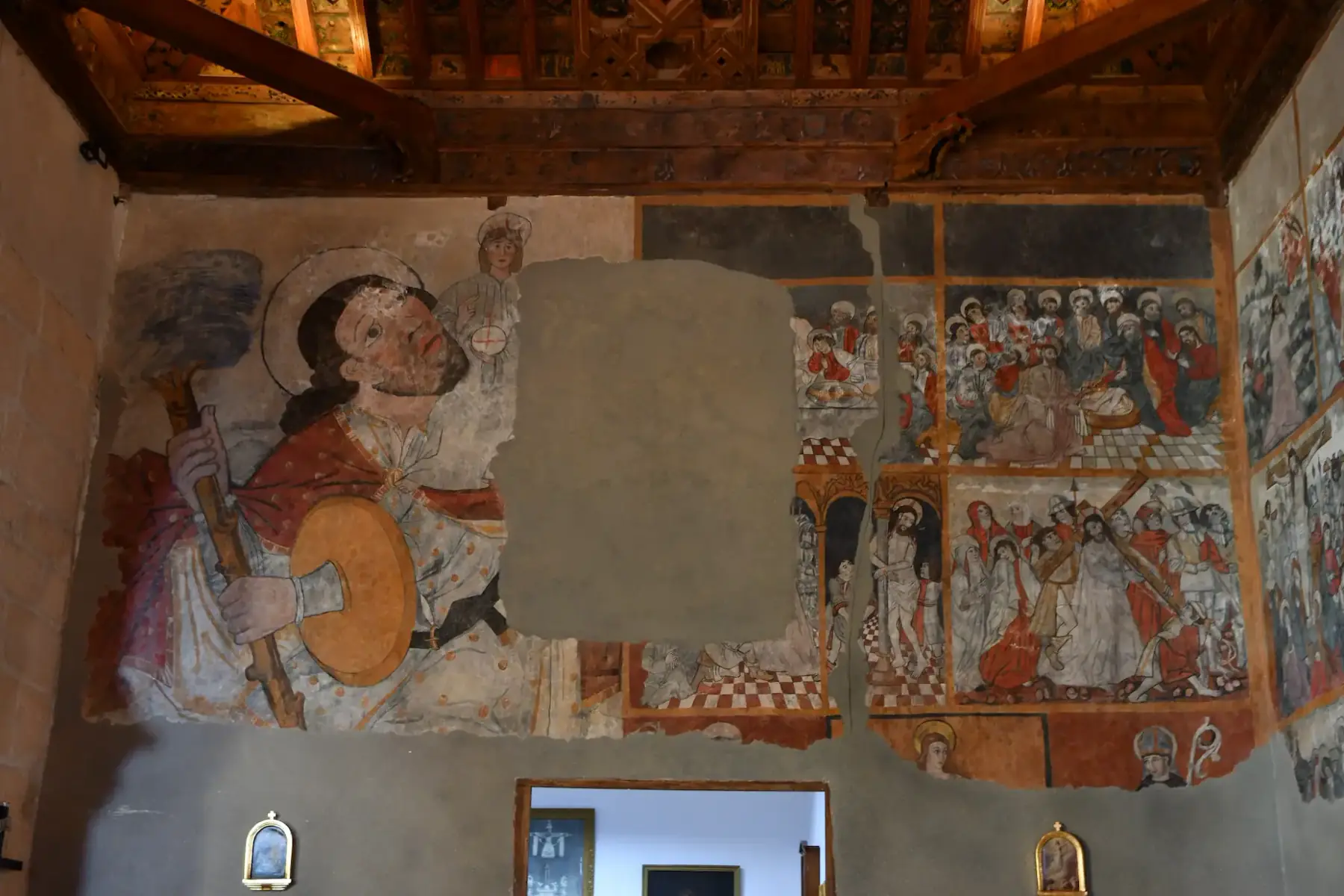
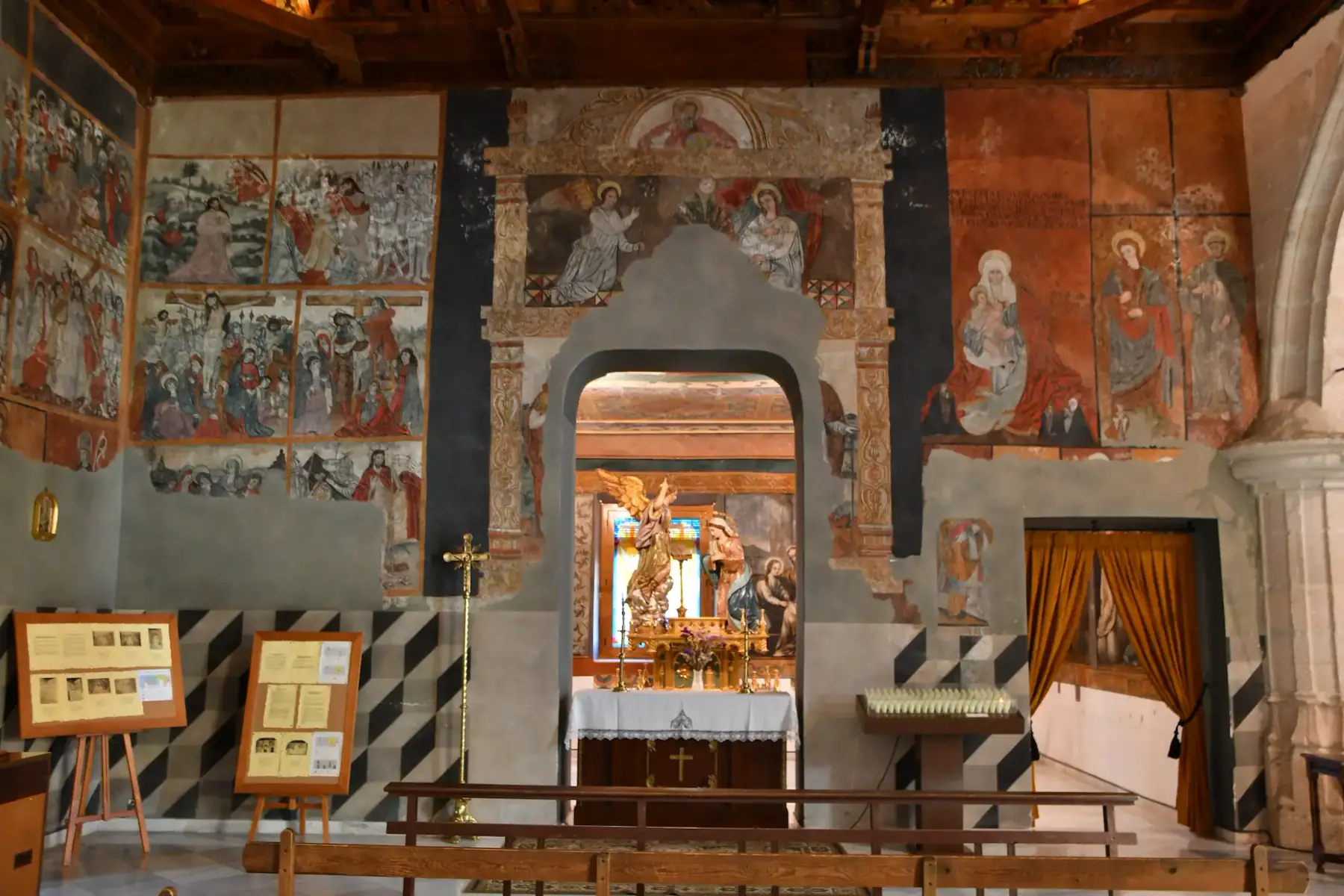
In this nave, we can contemplate two walls decorated with mural paintings created between the 15th and 16th centuries (beneath the Mudejar coffered ceiling).
The paintings from the late 15th century, in the Hispano-Flemish style, spanned both walls but were later reduced by renovations in the 16th century. At that time, the East wall was modified to create a pictorial altarpiece in the Plateresque style (finished in 1590, according to the text next to the altarpiece). In the early 18th century, when the camarín (shrine) of the Virgin was built, an access opening was cut through, and the area around it was decorated with paintings. The renovations of the late 18th and 19th centuries resulted in the total concealment of the paintings. The central niche of the pictorial altarpiece was transformed to create an opening that would allow a view into the Virgin's shrine. The entire original surface was hidden by a pictorial rendering imitating ashlar masonry, and the historical memory of these paintings' presence was lost until their restoration. The openings in the north wall must date from these periods: a square window centred on the wall replacing the vertical one from the 15th century, and the entrance door to the new sacristy, both breaking the pictorial surface.
Regarding the themes, starting with the North wall—which was heavily damaged by the opening of gaps that destroyed much of the pictorial space—we find, starting from the top left:
- Saint Christopher with the Christ Child on his shoulders, who in turn holds the orb or globus cruciger, representing the world topped with a cross. This is a large image compared to the others. Curiously, it is placed on the wall facing the Tobarra hill that was named after the saint (today known as Santa Bárbara or the Clock Hill), which may indicate the past veneration he had in the town.
- The Last Supper, very damaged.
- The Washing of the Feet.
- An almost vanished painting, which possibly had the Crowning with Thorns as its theme.
- The Road to Calvary. Note the caricature-like tone usually given to evil characters and the attire of secondary characters, surely based on the fashion of the time it was painted.
In the lower part, remains of saintly figures appear. Practically nothing is preserved of the first one except the upper part. The second is a martyr saint. The third is a bishop—Saint Augustine?
Continuing with the East wall, we find:
- The Agony in the Garden.
- The Arrest of Jesus, where we can see how, while Judas Iscariot betrays Christ with a kiss, Peter sheathes the sword with which he has cut off Malchus' right ear, which will later be healed by Jesus.
- The Crucifixion. Christ is flanked by Dismas and Gestas (the good and bad thieves, respectively), and beneath him are John, Mary Magdalene (with long, loose hair), and the Virgin, who faints before Mary Salome and Mary of Clopas. Next to these characters, soldiers cast lots for the condemned man's clothes with dice.
- The Descent from the Cross.
- The Resurrection.
The centre of this wall is occupied by the aforementioned 16th-century altarpiece, with two bodies flanked by Plateresque columns decorated with grotesques. Between the columns appear the remains of Saint John the Baptist and Saint Anthony Abbot. The missing part, as well as that of the central niche—which we can imagine closed with a scallop shell over pilasters of grotesques—disappeared when the wall was pierced to create the mouth of the shrine and introduce the throne of the Virgen de la Encarnación. In the second body, the Incarnation is represented, the moment of receiving the Holy Spirit; this is undoubtedly the oldest preserved representation in Tobarra. From the attic, the figure of God the Father leans out, making the gesture of blessing while holding the orb or globus cruciger and sending the Spirit in the form of a dove.
To the right of the altarpiece, there is an inscription providing very interesting data: This altarpiece was finished in the year 1590, Salvador de Ocaña being the steward of this church, son of Alonso Martínez de Valero.
Below the text appears the iconography of the Saint Anne Trinity (Santa Ana triple), as she holds the Virgin seated on her lap, who in turn holds the Child Jesus in her arms.
At her feet, to the right, a man and a woman representing the donors of the painting, and to the left, a young man, son of the former.
Next, we see Saint Margaret, recognizable by the crucifix and the martyr's palm in her hands and the dragon at her feet, and the donor of the work.
Continuing to the right, Saint Anthony of Padua with lilies, symbol of his purity, pointing to his heart (usually depicted in flames), symbol of his faith and love for Jesus and Mary. Finally, next to the door to the shrine, another bishop saint, of whom only a fragment remains.
From what is preserved of the upper part, we can guess that before the opening was made, at least three more representations existed.
Among these figures, there are partially legible inscriptions in Gothic script, which basically state who ordered some of the paintings to be made, although it is not appreciated due to the condition in which they have reached us.
This different script places us, at a glance, almost a century earlier and could be key to dating the Passion series paintings.
The plinth of both discussed walls appears decorated with geometric prism motifs.
The restoration was carried out by Ars Nova CB starting in early August 2000, co-financed by the Brotherhood and the Department of Culture of Albacete. The paintings were discovered under two layers of plaster and several layers of paint and surface whitewash, with significant conservation deficiencies, as well as deficiencies in their formal presentation (deposits of surface dirt hiding the paintings, loss of surface unity due to numerous pick marks throughout, irretrievable loss of mural surface...). The restoration attempted to return maximum visual unity to the ensemble.
Images
Left wall
Photo: Elena Lisón Sánchez
Right wall
Photo: Elena Lisón Sánchez
Bibliography
- •El reloj de la Villa. José Rafael Navarro.
- •"Santuario de la Encarnación y Cristo de la Antigua en la Villa de Tobarra". Libro de Semana Santa de Tobarra, 1999. Luis Enrique Martínez Galera.