History
Above this nave, one of the oldest in the Santuario de la Encarnación (the one preceding the Virgin's shrine), rises a Mudejar collar-beam coffered ceiling (par y nudillo) with two central tie beams. It features interlaced work with eight-pointed stars in the central panel (almizate), creating a central eight-pointed wheel or alfardones, at the centre of which appears a moçárabe pinecone or pendant.
The backgrounds of the coffers are adorned with carved six-petalled flower circles (hexafolias) which have lost their original polychromy. The troughs (each of the ornamented square spaces forming the ceiling) are decorated with vegetal motifs of intertwined leaves and flowers. In the lower sections, we see the alternating coats of arms of Castile and León, interrupted only by two successive boards featuring blurred inscriptions. One seems to be the classic IHS and the other YPS in Gothic script (located just above the sacristy door). On the upper part of the frieze, there are shields with a floreated cross gules on a field azure. The tie beams emerge from the frieze resting on corbels: four short ones in the corners, and two long ones across the width.
We could place its origin in the first half of the 14th century, perhaps even a little earlier, though we do not know the ceiling's provenance. It was not initially conceived for this temple, as it is evident that it was moved and adapted from another building (possibly civil in nature, as deduced from its decoration). This is noticeable in the northern half, where we see two pairs of hip rafters very close together, with barely any space for the panels, making it asymmetrical.
The passage of centuries and human intervention eventually hid its splendour. Before the restoration in the 90s, it was covered by a dark brown pictorial layer, ornamented with dark lines marking decorative motifs following the geometric lines of the structure. When the company Antícoli performed the first cleaning tests on one of the boards, they found a white layer of tempera and lime beneath the paint, and beneath that, the original polychromy. The company carried out the cleaning using solvent mixtures and mechanical procedures. The reintegration of the intrados (visible part) was minimal, as it did not suffer from major losses, with the mouldings of the central section of the lower part being replaced. On the extrados (the upper part we do not see), structural work, disinfestation, and cleaning of dust, rubble, and bird droppings were carried out. The rafters and hip rafters cut at one end were replaced, and steel tie rods were installed to prevent a lateral part of the ceiling from shifting downwards. The metal structure of the Sanctuary's roof, the work of architect Esteban Belmonte, features an iron beam that supports said tie rods. Beneath the coffered ceiling, in the northwest corner of this nave, stands the pulpit from which Saint Vincent Ferrer preached to the people of Tobarra on the 24th of April, 1411.
Images
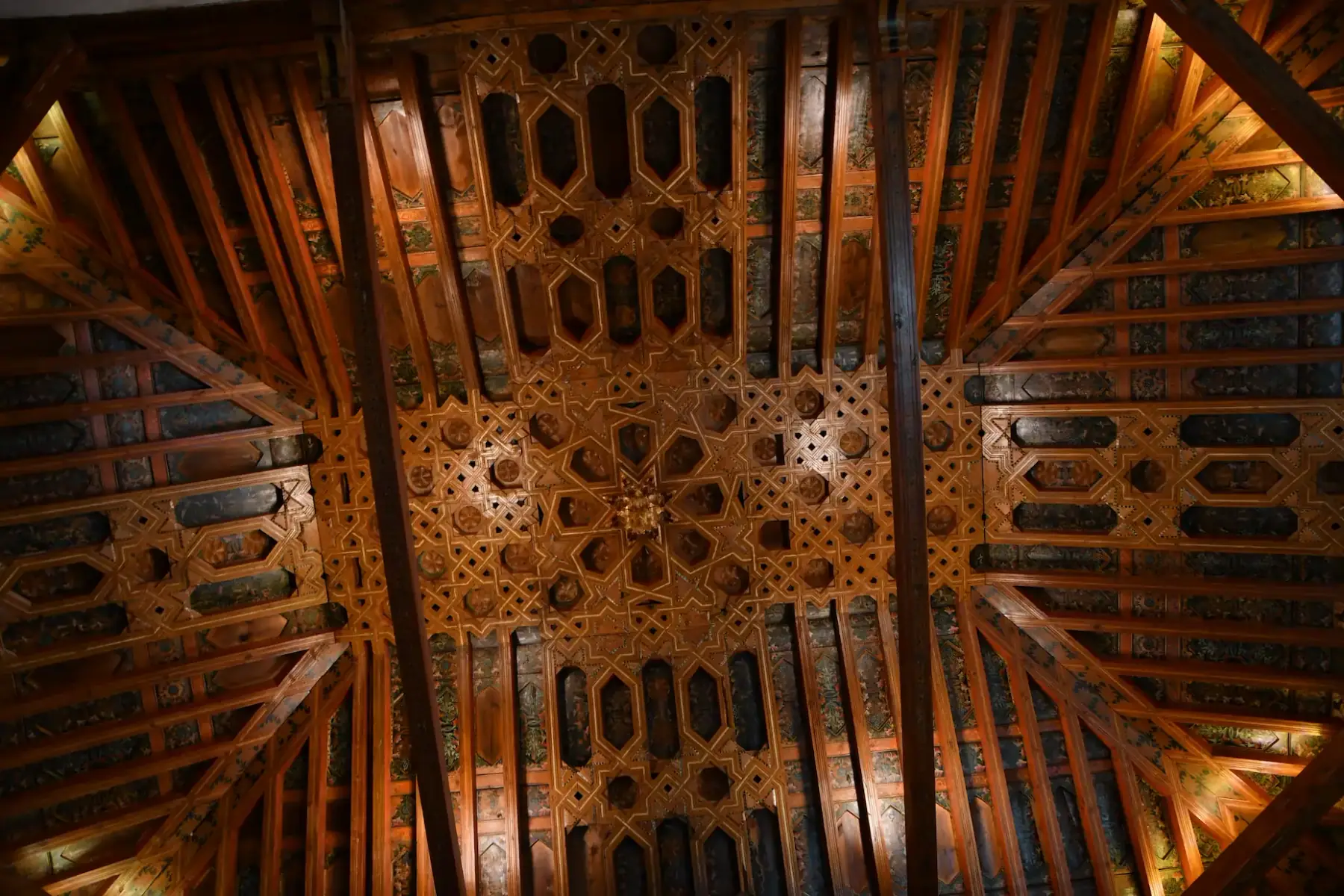
The restored Mudejar coffered ceiling
Photo: Elena Lisón Sánchez
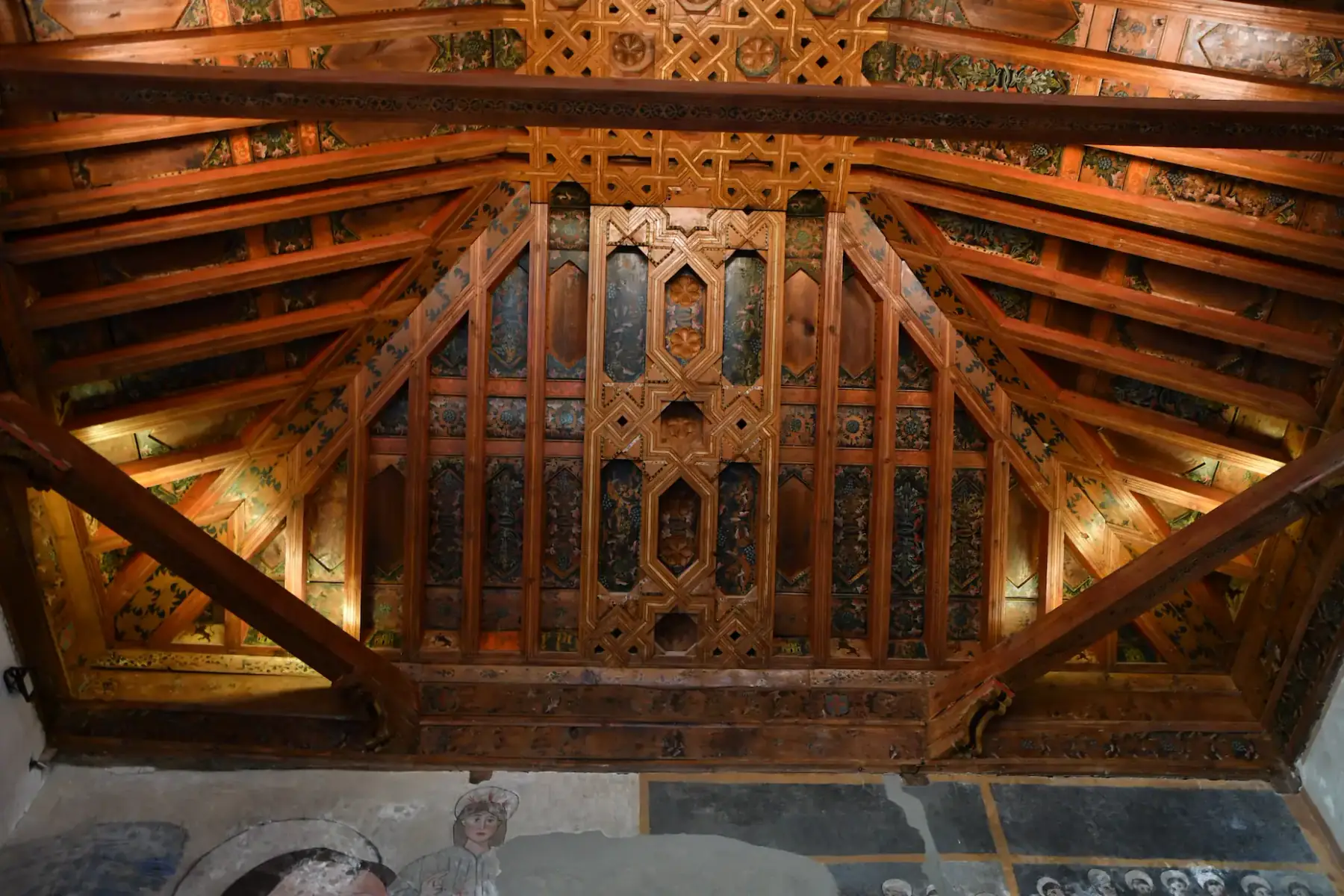
The restored Mudejar coffered ceiling
Photo: Elena Lisón Sánchez
Bibliography
- •El reloj de la Villa. José Rafael Navarro.
- •"La práctica de la restauración (IX). El Santuario de la Encarnación de Tobarra. Artesonado mudéjar". La Tribuna Dominical. María Dolores Barnuevo Cabanillas y Pablo González Cerón.
- •"Santuario de la Encarnación y Cristo de la Antigua en la Villa de Tobarra". Libro de Semana Santa de Tobarra, 1999. Luis Enrique Martínez Galera.