History
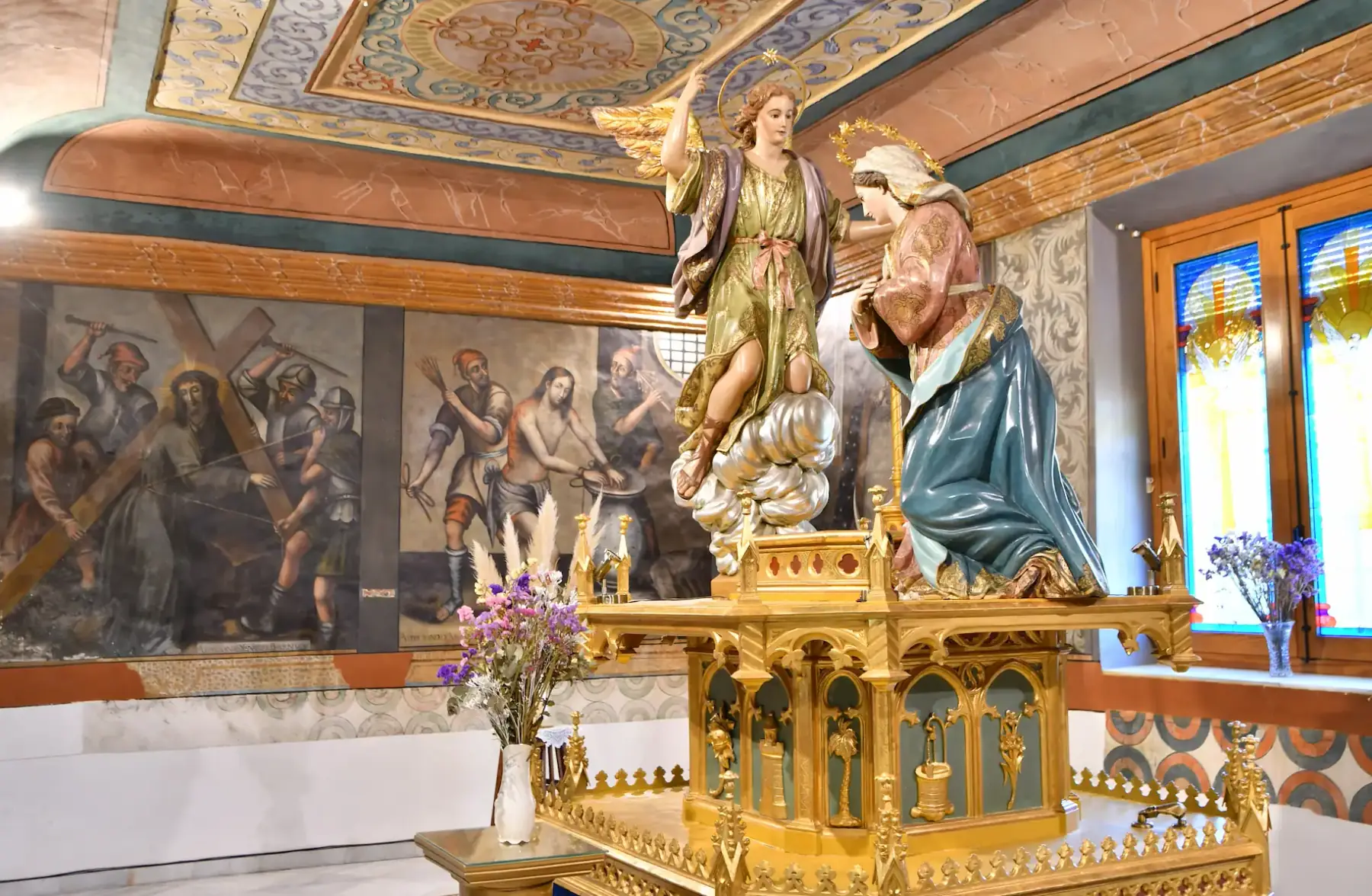
The simple camarín (shrine) of the Virgen de la Encarnación, patron saint of Tobarra, is a rectangular room with a flat ceiling that must have been built in the late 17th or early 18th century, although its formal simplicity might suggest earlier dates. From the morphology of the building, we know it was constructed prior to the shrine of the Cristo de la Antigua, as a parallel addition to the nave of the coffered ceiling. The date of construction, who promoted it, and the costs incurred are unknown. However, it is certain that it was finished in 1717, because the mural decoration is dated to that year.
The paintings are executed using the tempera technique, applied in thin layers of similar thickness with pigments of various colours (vermilion, calcium carbonate, organic black, white lead, indigo blue, smalt blue, earth tones...) where dark and warm tones predominate, with an elaborate finish lacking impasto, glazes, or noticeable brushstrokes. A logical natural patina envelops the ensemble. Some paintings sit upon earlier executions, as stratigraphic analyses have detected. Dampness has deteriorated the support and mortar, causing cracks in the walls and moisture stains on the paintings, causing enormous losses in some of them.
The paintings represent scenes from the life of the Virgin and Christ, in an order that is in some cases arbitrary. Starting from the central axis of the shrine, we distinguish two different zones: the first, upon entering, referring more to Mary with her joys; and the second, referring to the sorrows of the Virgin through the Passion of Christ:
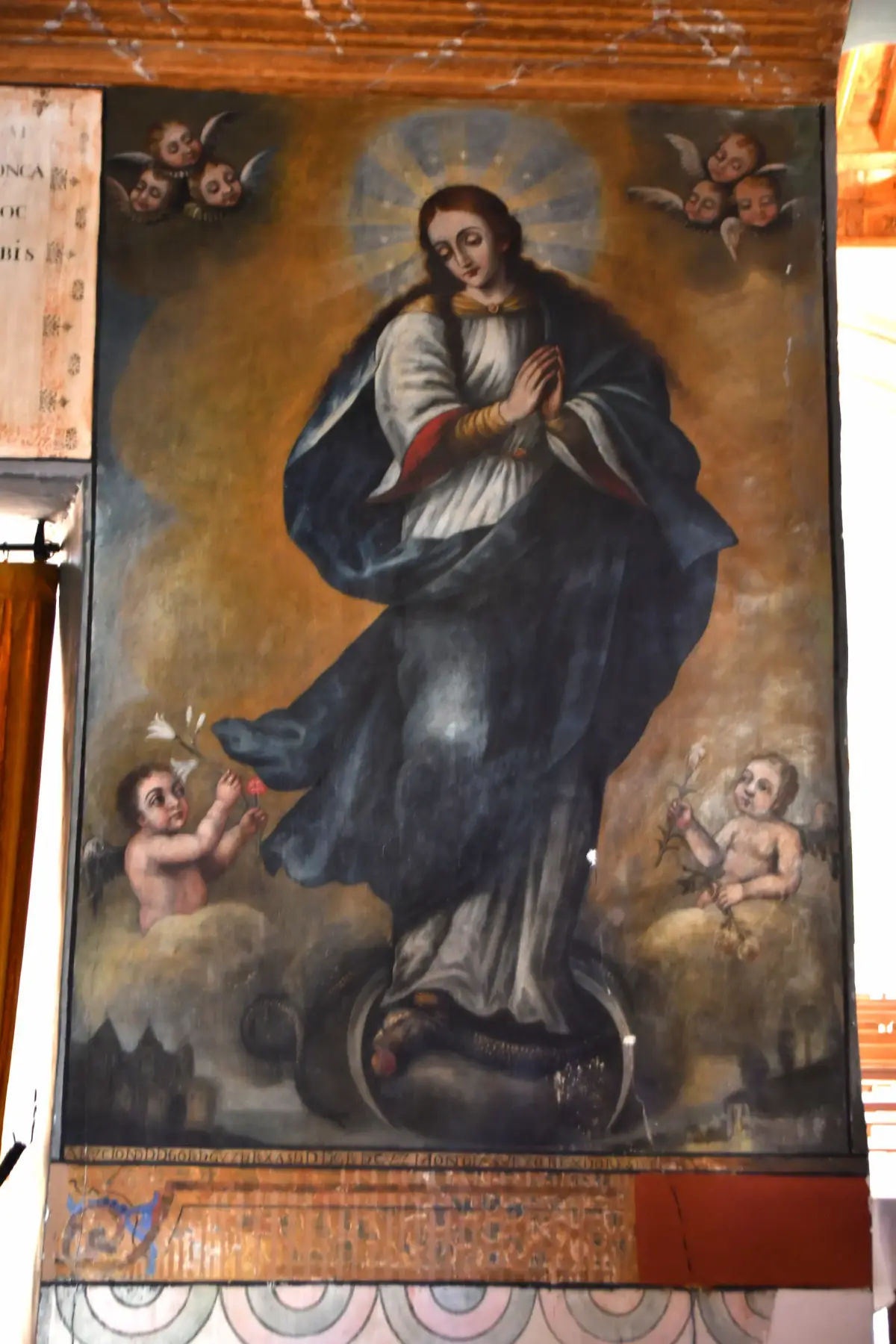
The Immaculate Conception
Measuring 2 metres high by 1.30 metres wide, it is located to the left of the entrance. The Immaculate One is the Virgin chosen before her birth, conceived before Eve, in eternity, as a necessary means for the Incarnation of the Son of God. She descends from heaven, with her eyes fixed on the earth, her foot upon the moon and crowned with stars, whilst joining her hands over her chest. The Virgin is young, with brown hair tending towards dark, dressed in a white tunic and blue mantle, with the points of the moon facing downwards. In the upper corners appear three winged heads, and two angels in the lower part, carrying flowers referencing Mary's virginity. We are facing the evolved model of the Immaculate Conception consecrated in the 17th century. However, we find earlier reminiscences in the flowers held by the angels: lily "sicut lilium inter spinas" (like a lily among thorns) and roses: "plantatio rosae" (rose plant). In the lower part appear others such as a city with its towers: "civitas Dei" (City of God) on the left, and on the right a walled enclosure: "hortus conclusus" (enclosed garden) and on the slope of the horizon symbolic vegetation: olive tree "oliva speciosa" (fair olive tree), a cedar "cedrus exaltata" (exalted cedar), palm tree "palma exaltata" (exalted palm tree) and a cypress "cipresius in Sion" (like a cypress in Zion).
Donor: "AT THE DEVOTION OF D. DIEGO RODRÍGUEZ DE ROXAS AND OF DIEGO RODRÍGUEZ MONTOIA HIS SON, ALDERMEN OF THIS TOWN".
Diego married María Laurencia Ruiz Pérez y Montoya in his first nuptials and in 1703, in second nuptials, Josefa Pérez Pastor. His son Diego Rodríguez Montoya married Isabel Mateo Carcelén in 1695, becoming a widower in 1717 and marrying Quiteria Marín Blázquez in 1722. He was buried in the parish in 1726.
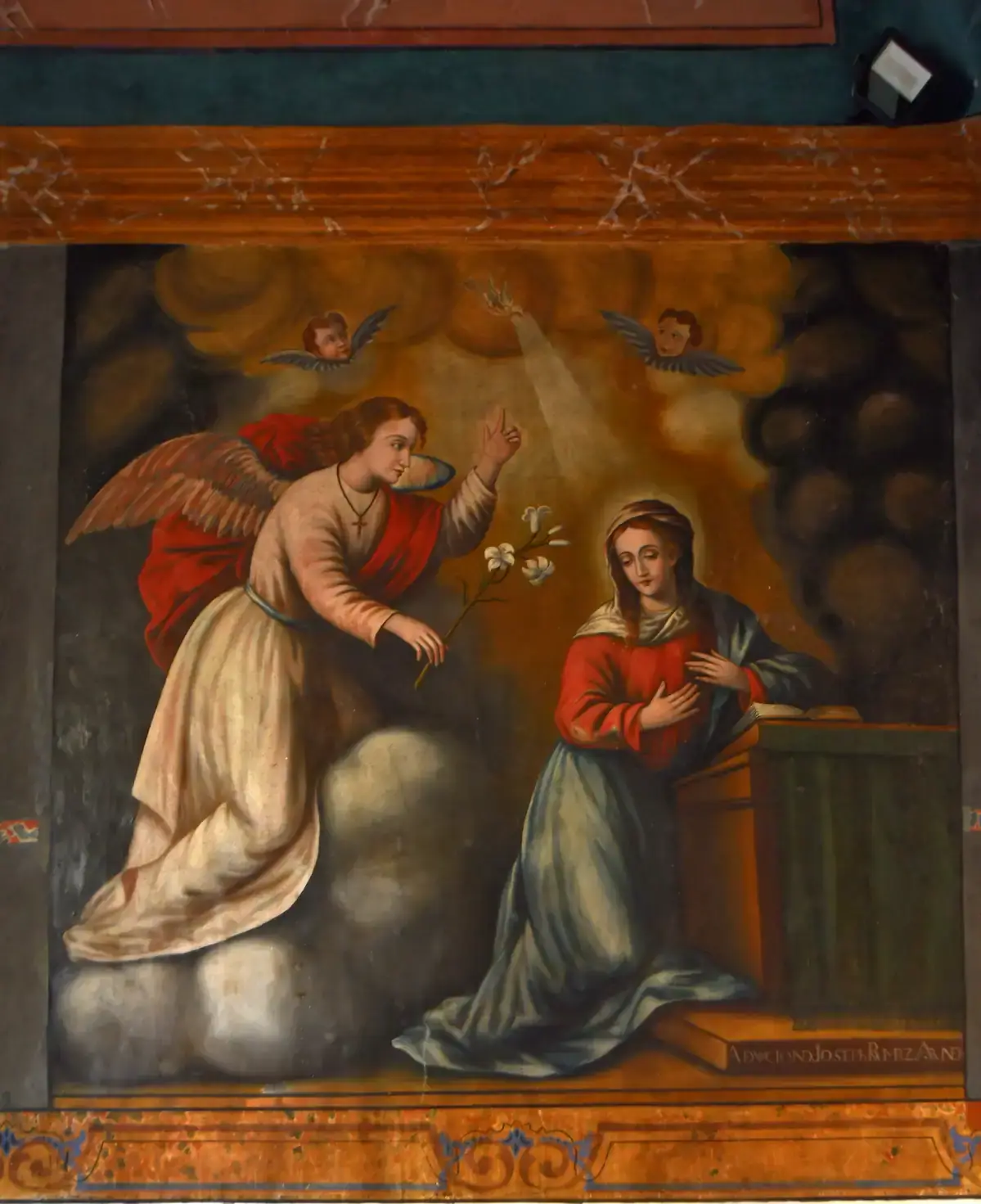
The Annunciation
Measuring 2 metres high by 2 metres wide, specifically this concerns the mystery of the Incarnation of the Son of God, as the dove representing the Holy Spirit appears. The painter, following the guidelines of Trent, has removed all elements of daily naturalism from the scene to develop the divine ones. Mary is surprised while praying, immersed in reading the book she has open on the lectern, kneeling with her arms crossed over her chest, turning towards the unexpected visit of the Archangel Gabriel, who floats on a cloud and offers Mary the lily staff, a sign of purity. Meanwhile, he raises the index finger of his left hand upwards, indicating his origin as a messenger of God and the Holy Spirit, from whose head springs a beam of light illuminating Mary's head. Two winged heads appear: the one on the right seems to be a repaint or later addition due to stylistic differences with the rest of the work, perhaps the result of the 1881 restoration.
Donor: "AT THE DEVOTION OF JOSEPH RAMÍREZ ARNEDO". Married to María Ródenas Muñoz in 1704 and buried in the Convent in 1743.
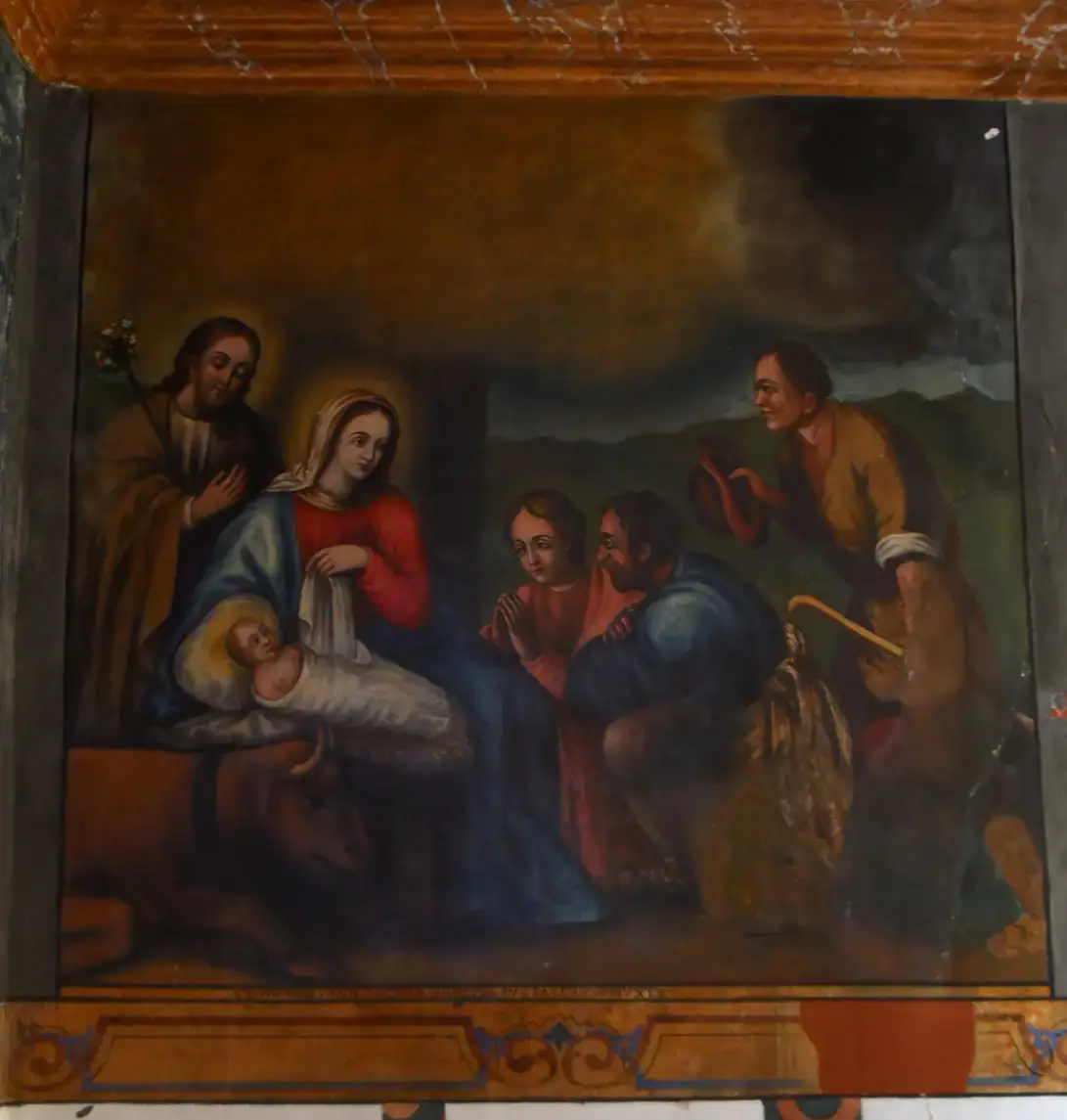
The Adoration of the Shepherds
Measuring 2 metres high by 2 metres wide, there are three shepherds who come to adore the Child, balancing the scene with that of the Kings from the East. However, classic gifts such as the lamb, the crook, and the flute are omitted. Two appear kneeling, whilst the third bows, uncovering his head. Before them is the Holy Family: Joseph with his flowering staff, with Mary showing the Child to the shepherds. Of the characteristic animals, only the ox appears in the lower part of the scene.
Donor: "AT THE DEVOTION OF FRANCISCO DE OCHOA AND OF JOSEPHA BALERO HIS WIFE". Francisco Ochoa, native of Albatana, son of Alonso Ochoa and María Vera, was baptized in 1675. He married Josefa Ruiz Valero, daughter of Joseph Ruiz and Ana Ibañez, in 1715.
The Adoration of the Magi
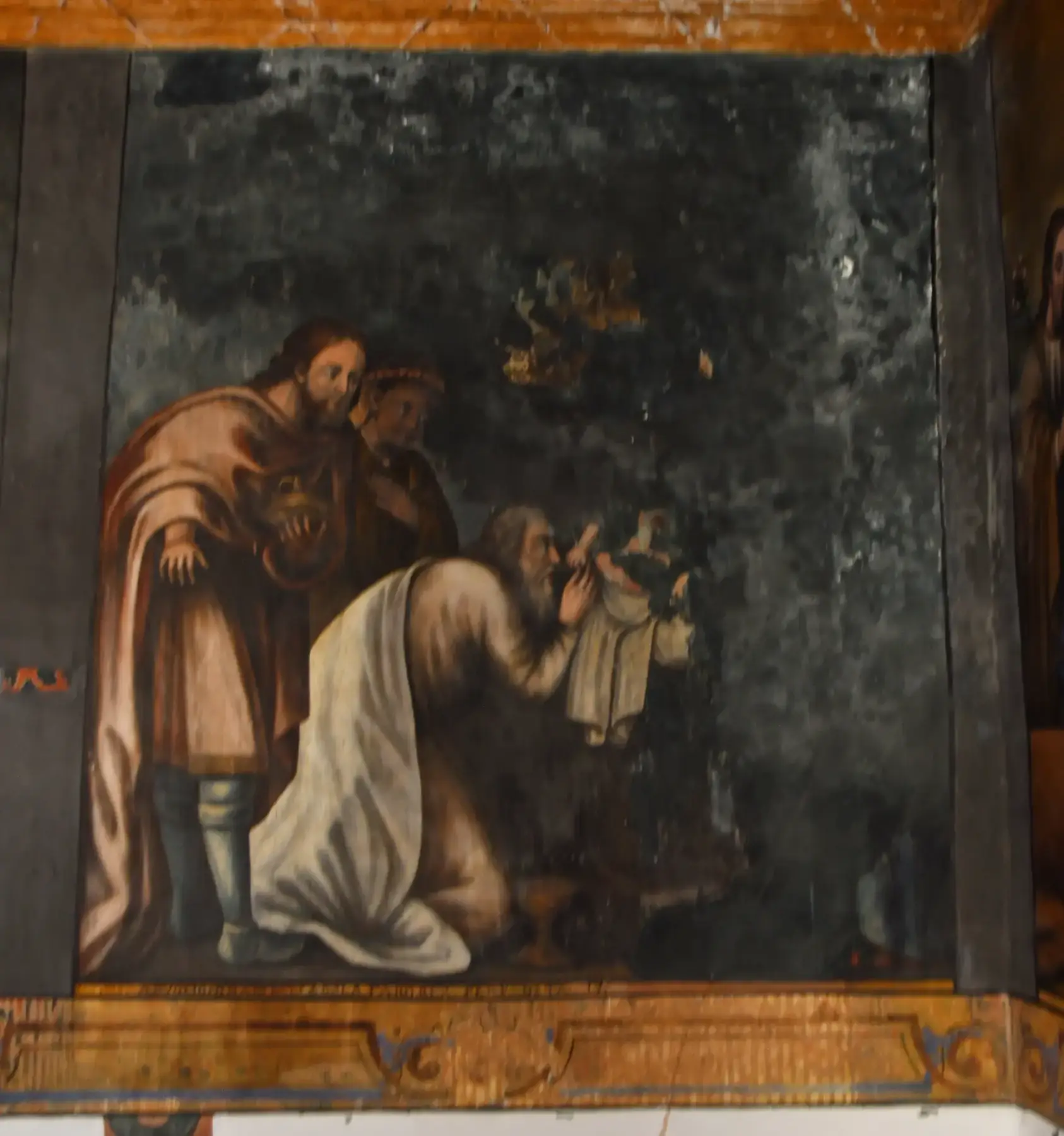
Measuring 2 metres high by 1.68 metres wide, this is the most damaged mural, with almost half of it lost. The three kings have been preserved, following common criteria: Melchior, elderly with white hair and long beard; Gaspar, middle-aged with a short beard; and Balthasar, beardless and black, representing the ages of life and the ethnicities of the different parts of the known world: Europe, Asia, and Africa. Melchior, with his gift on the ground, kneels making a gesture to kiss the Child's hand, while Gaspar and Balthasar bow in reverence. Only two gifts appear: the gold in the cup on the ground and the jar of incense. The myrrh remains hidden. Opposite them, we must imagine Mary seated with the Child and Joseph standing.
Donor: "AT THE DEVOTION OF D. ANTONIO BALCÁRZEL ALFARO, PERPETUAL ALDERMAN OF THIS TOWN".
The Education of Mary
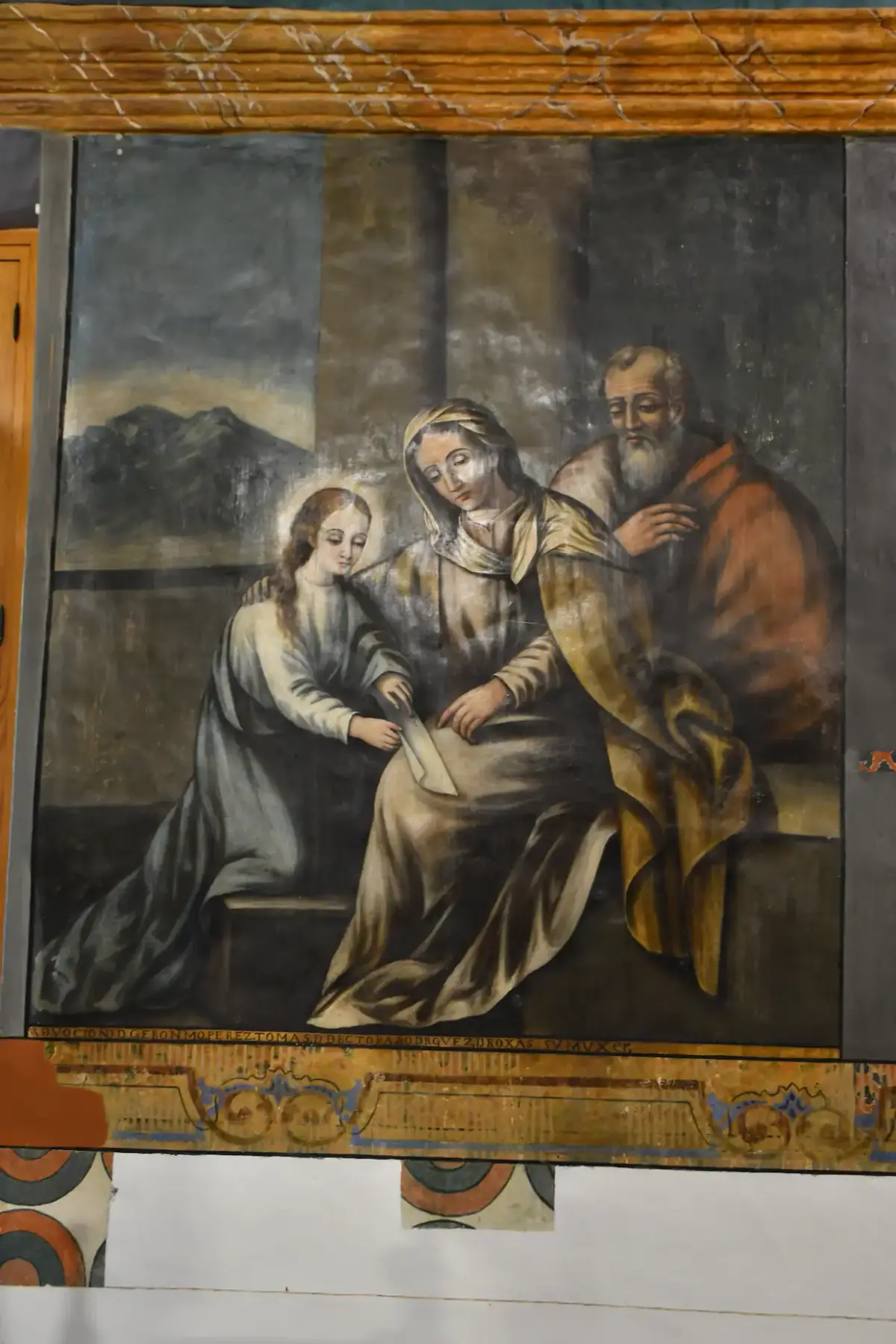
Measuring 2 metres high by 1.65 metres wide, in a room through whose window a mountainous landscape can be seen, Anne is teaching a young Mary, holding her by the shoulder while with the other hand she points to the text of a parchment the girl holds in her hands. Her father, Joachim, in the background, assists in his wife's educational task. The theme appears at the end of the Middle Ages and becomes popular from the 16th century onwards, linked to the progress of the cult of Saint Anne, to whom popular devotion insisted on attributing a role in Mary's education, despite lacking biblical foundation.
Donor: "AT THE DEVOTION OF D. JERÓNIMO PÉREZ TOMÁS AND Dª BICTORIA RODRÍGUEZ DE ROXAS, HIS WIFE". Don Jerónimo was baptized in 1675, son of Juan Pérez Vera and María Tomás. Fue enterrado en la Asunción en 1746. Doña Victoria was baptized in 1677, daughter of Diego Rodríguez de Vera y Rojas and María Laurencia Ruiz Pérez y Montoya, and was buried in the chapel of San Antonio of the Convent in 1745.
The Virgin of Solitude
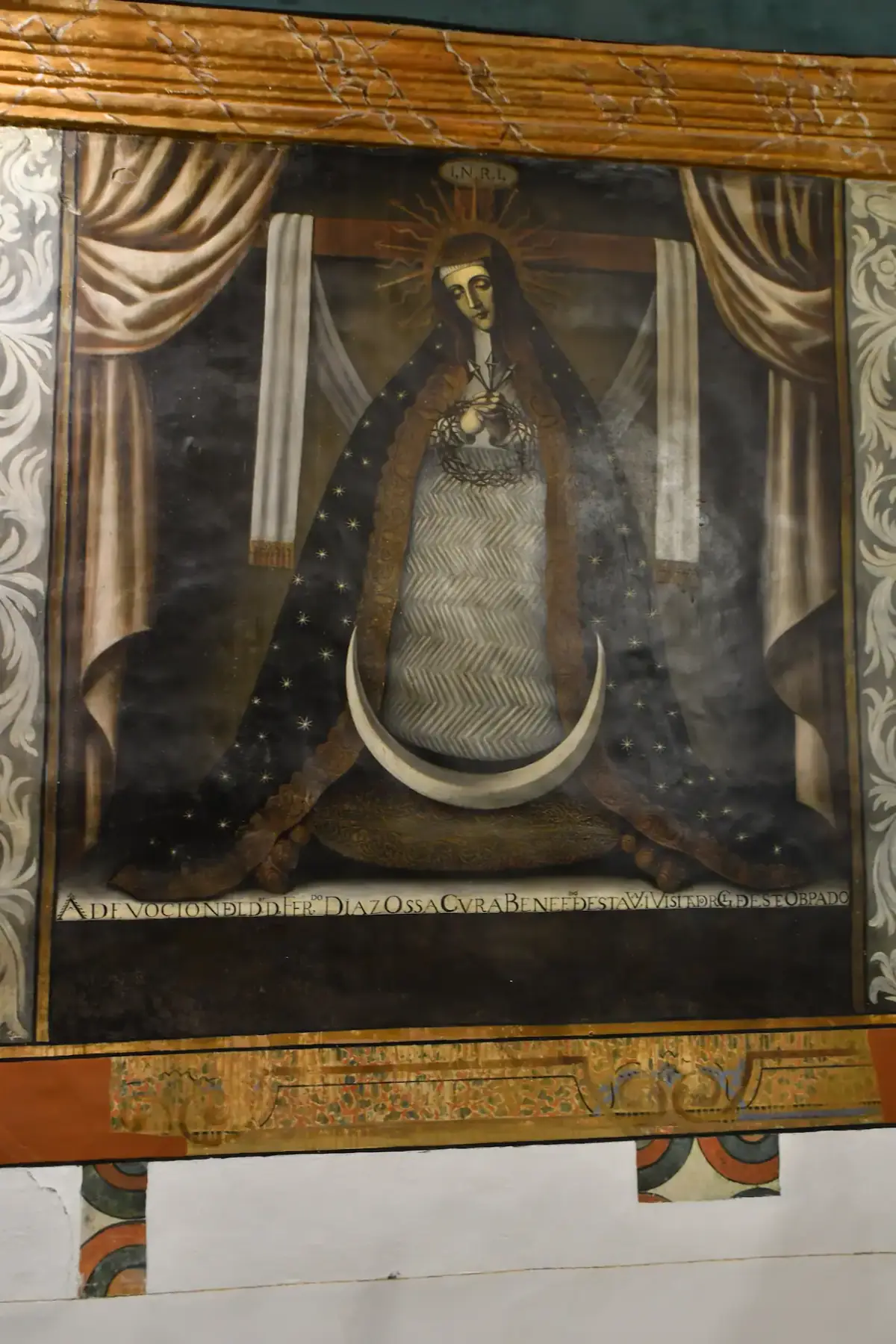
Measuring 2 metres high by 1.70 metres wide, the composition, far from Baroque naturalism, presents the Virgin enthroned; two curtains open to reveal and centre the image, which is an abstraction, enjoying the properties of a dressed sculpture (escultura de vestir). A large starry blue mantle, like the night sky, with a golden border contrasts with the white zigzagged fabric of the dress. Crowned with a radiant crown like a 17th-century monstrance, she tilts her head to her right and lowers her gaze in a sign of internalised pain; she joins her hands beneath the mantle carrying the crown of thorns and the three nails in an emblematic manner. From the Virgin of Pity, she inherits the cross and the shroud in the background.
Donor: "AT THE DEVOTION OF D. FERNANDO DÍAZ OSSA BENEFICIARY PRIEST OF THIS TOWN AND GENERAL VISITOR OF THIS BISHOPRIC".
He took possession as beneficiary and parish priest in October 1709, and appears signing as parish priest until November 1717 and as General Visitor of the Bishopric of Cartagena, in the name of Bishop D. Luis Belluga in 1718 and 1720. His mother, Isabel Díaz Ossa, was buried in the parish in 1731. This inscription is a repaint, apparently motivated by his sudden promotion in 1717 as general visitor, thus including the donor's new status.
The Flagellation
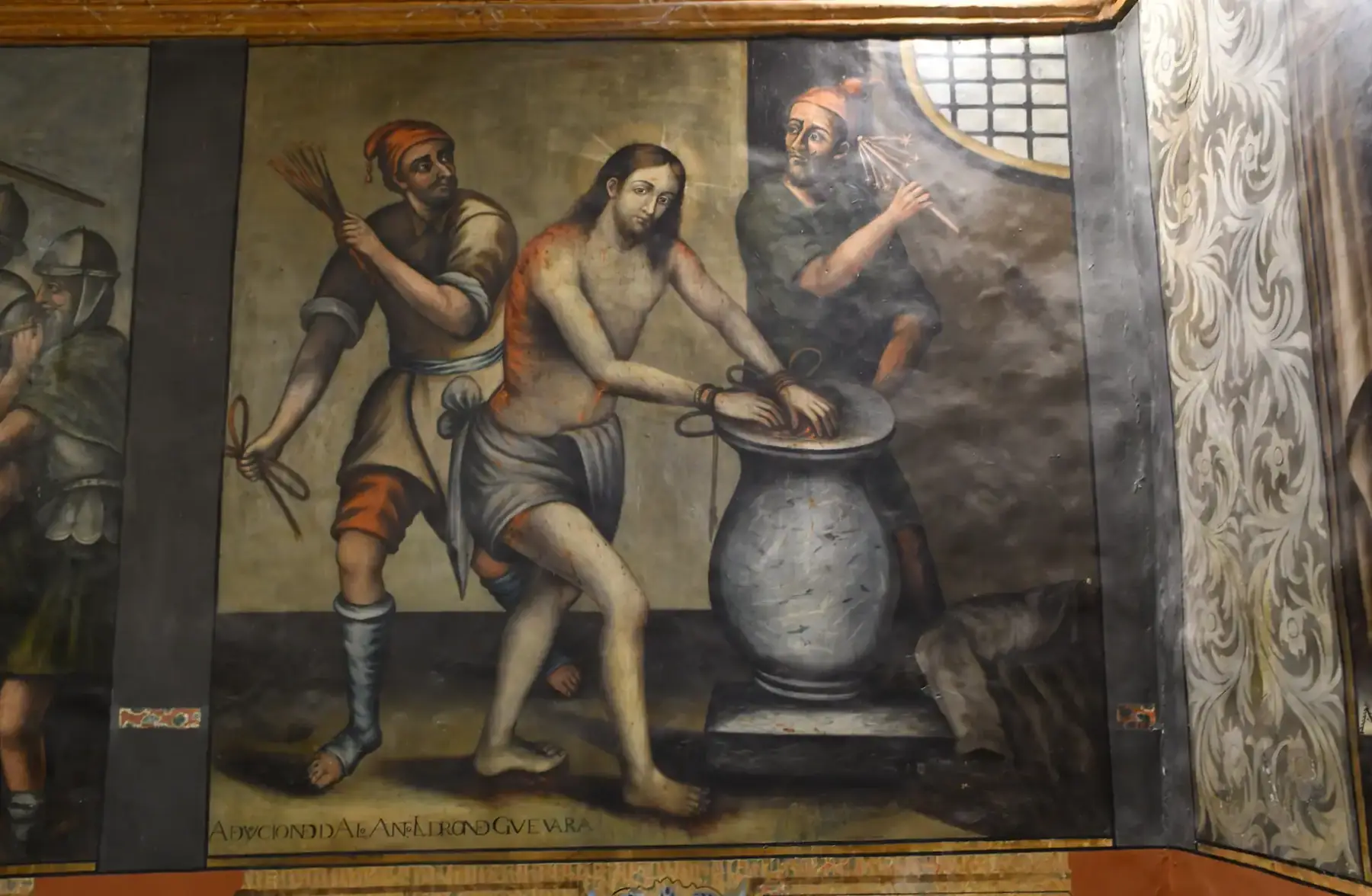
Measuring 2 metres high by 2 metres wide, the evangelical texts limit themselves to saying that Jesus was whipped, without mentioning any column; nevertheless, this theme has become popular in art. Here the scene is represented with great simplicity. Christ appears standing, without a tunic, covered only by some cloths, and with his hands tied to a short column like a baluster, following the criteria of the Counter-Reformation. His head bears the luminous nimbus with the characteristic three rays (potencies). His serene gaze is directed at the viewer. Meanwhile, his executioners whip him, one with a bundle of rods, and the other with a flagelum: a whip of leather straps ending in lead balls with spikes.
Donor: "AT THE DEVOTION OF D. ALONSO ANTONIO LADRÓN DE GUEVARA". He was buried in the Convent in 1743.
The Road to Calvary
Measuring 2 metres high by 2 metres wide, Christ is in the centre with the cross; two soldiers beat him in the background and another on the right pulls him by the rope tied to his waist. Meanwhile, Simon of Cyrene, on the left, helps him with the cross. The contrast between the fineness and nobility of the execution of the Nazarene's head and the rough execution of the rest of the characters is noteworthy.
Donor: "AT THE DEVOTION OF D. FRANCISCO CARZELÉN BARNUEVO". Son of Joseph Carcelén and María Rodex, married to Ana Francisca Buendía, of whom he was widowed in 1725. He was buried in the Asunción in 1731.
The Crucifixion or Calvary
Measuring 2 metres high by 2.12 metres wide, in the centre, Jesus appears nailed to the cross, from which hangs the cartouche in the form of a parchment with the famous INRI (Jesus of Nazareth, King of the Jews). Apparently, he is dead due to his closed eyes. At his feet, Mary Magdalene embraces the timber; to the left, with joined hands (appearing more in prayer than in pain) is Mary, and to the right, John, with clasped hands and a gaze lost on the horizon.
Donor: "AT THE DEVOTION OF D. FRANCISCO OCHOA LIEUTENANT PRIEST OF THIS TOWN". He remained in Tobarra between 1714 and 1719.
Above the access door was a cartouche, result of the 19th-century restoration, which said: "THIS SHRINE WAS FINISHED. YEAR 1717. IT WAS RESTORED YEAR 1881."
Beneath this, letters of an earlier one showed through, whose text seemed richer in detail, so it was uncovered during restoration: "THIS SHRINE WAS FINISHED YEAR OF 1717 BEING BISHOP OF CARTAGENA THE MOST EXCELLENT DON LVIS BELLUGA Y MONCADA BENEFICIARY PRIEST OF THE PARISH OF THIS TOWN THE DOCTOR DON FERNANDO DÍAZ OSSA GENERAL VISITOR OF THIS BISHOPRIC STEWARD OF THIS CHURCH JUAN MARTINEZ ORTIZ."
Above the cornice appears another inscription reading: "THIS SHRINE WAS RESTORED BY MARCIAL FERNANDEZ Y MOLINA. YEAR 1881"
Maria Dolores Barnuevo, responsible for the latest restoration, points out how the contributions of the 19th-century intervention are technically and aesthetically inferior in quality to the original paintings. To this intervention belong the ochre borders repainting the old mottled motif and the entire ceiling.
This shrine, in addition to being historically the place of worship for the Virgen de la Encarnación, served between 2014-2018 as the home for the images of Nuestro Padre Jesús Nazareno and the Virgen de los Dolores, due to the restoration of the Church of the Asunción. Subsequently, it has also temporarily housed one of the images of the Virgen de la Soledad and the Risen Christ.
Images
The Shrine of the Virgen de la Encarnación
Photo: Elena Lisón Sánchez
Painting 1
Photo: Elena Lisón Sánchez
Painting 2
Photo: Elena Lisón Sánchez
Painting 3
Photo: Elena Lisón Sánchez
Painting 4
Photo: Elena Lisón Sánchez
Painting 5
Photo: Elena Lisón Sánchez
Painting 6
Photo: Elena Lisón Sánchez
Painting 7
Photo: Elena Lisón Sánchez
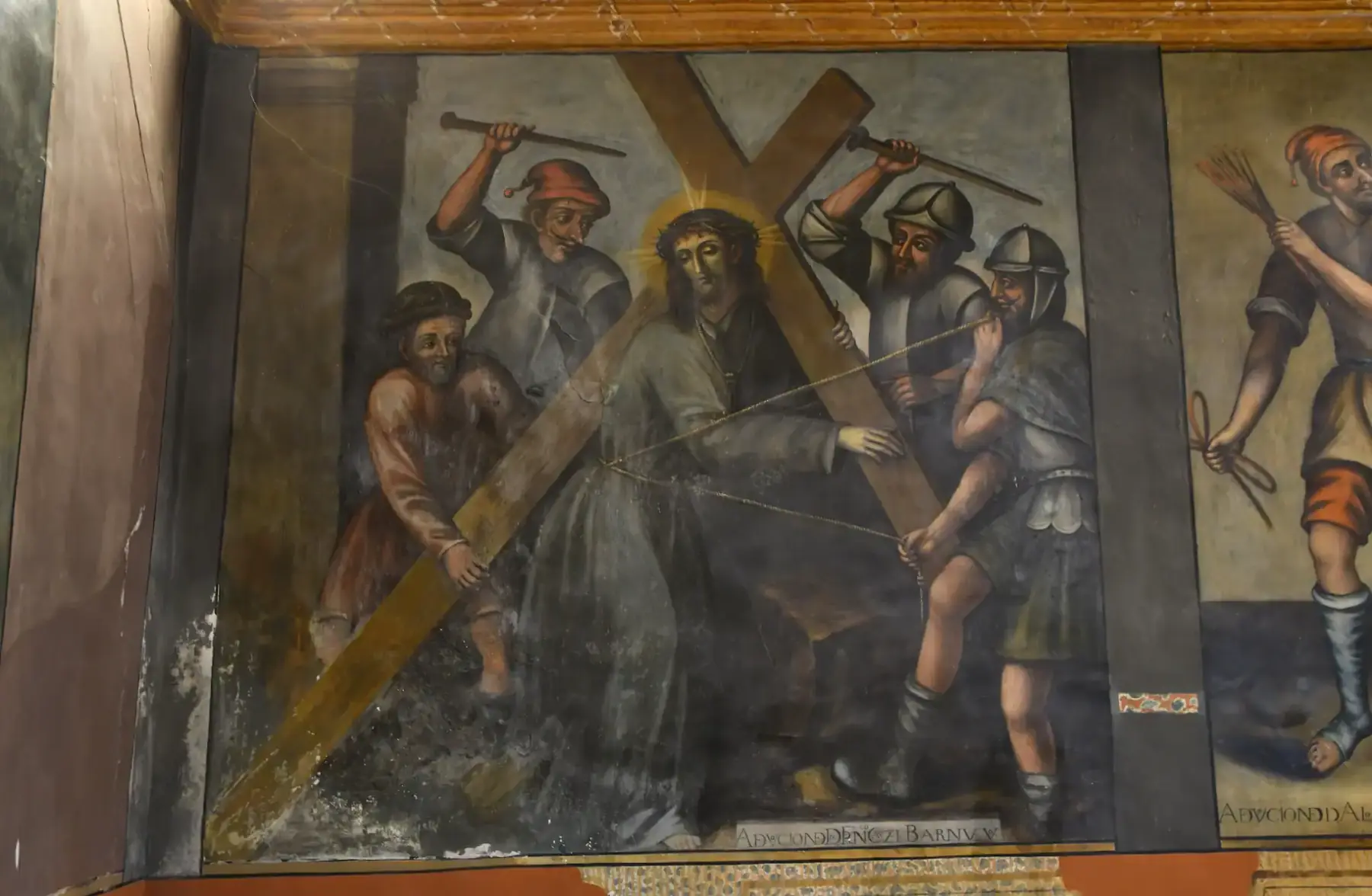
Pintura 8: Camino del Calvario
Photo: Elena Lisón Sánchez
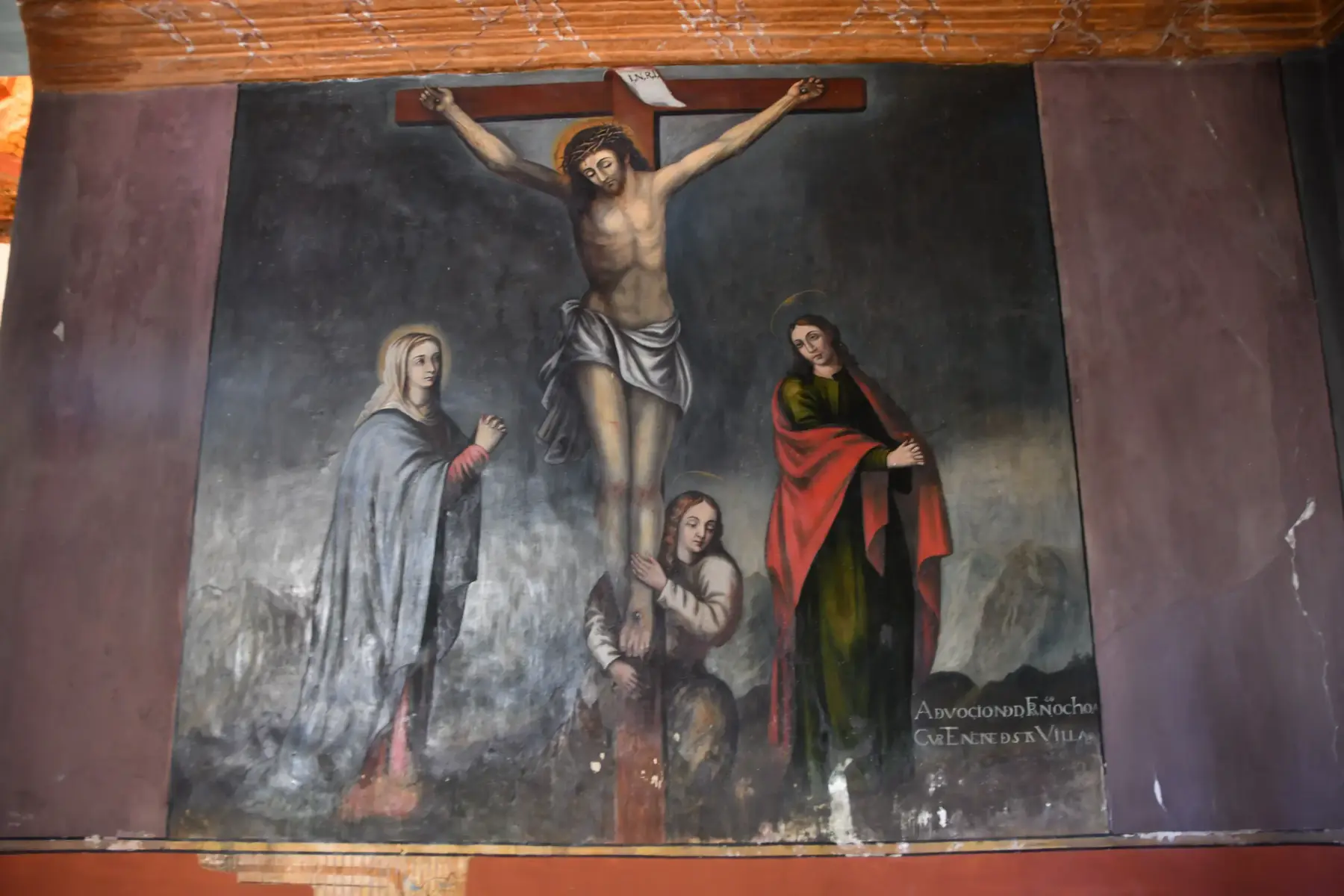
Pintura 9: La Crucifixión o Calvario
Photo: Elena Lisón Sánchez
Bibliography
- •El reloj de la Villa. José Rafael Navarro.
- •"La práctica de la restauración (VII): Santuario de la Encarnación de Tobarra. Virgen de la Encarnación: camarín". La Tribuna dominical. María Dolores Barnuevo y Pablo González.
- •"Mirando al pasado. Las pinturas murales del camarín de la Virgen de la Encarnación". Libro de Semana Santa de Tobarra, 1998. Luis Enrique Martínez Galera.
- •"Santuario de la Encarnación y Cristo de la Antigua en la Villa de Tobarra". Libro de Semana Santa de Tobarra, 1999. Luis Enrique Martínez Galera.